Recycled roads, renewable binders: inside the BRAVE project
A new EU-funded research project is investigating whether renewable bio-binders can enable repeated use of asphalt roads without compromising performance. Nynas is a partner in the two-year project, which could provide useful insights into asphalt recycling in Europe.
When an asphalt road reaches the end of its life, it doesn’t have to go to waste.
The old surface can be milled as reclaimed asphalt pavement (RAP), mixed with fresh material, and laid again.
Raising the share of RAP in new roads is one of the most direct ways to cut the sector’s use of virgin resources. Replacing fossil-based binders with renewable alternatives is another. A new EU-funded research project known as “BRAVE” sets out to understand what happens when the two are combined.
“BRAVE attempts to assess the recyclability of asphalt roads in combination with fresh renewable binders that are not fossil fuel-based,” says Georgios Pipintakos of Aristotle University of Thessaloniki, who is leading the project.
When old binder meets new
Recycling asphalt is more complex than it sounds.
As a road ages, the bitumen holding it together becomes stiffer and more brittle. Fresh binder has to restore those properties – and the old and new materials need to work together.
Much is known about how conventional bitumen behaves in recycled asphalt. Far less is known about bio-binders, which vary widely in composition.
How compatible are they with aged binder? How do they age over time? And can the resulting material be recycled again?
BRAVE tackles these questions through a systematic programme of laboratory work. Binder recovered from five European road sections, of different ages and bitumen sources, will be blended with three bio-binders of varying types at recycling rates of 30 and 60 percent.
In Europe, recycling rates currently reach around 30 to 35 percent in the best cases, says Pipintakos, while research suggests that 50 percent could be achievable. Testing at both 30 and 60 percent allows BRAVE to compare today’s level with a considerably higher one.
The project is the first to account for the natural variability of RAP when optimising its compatibility with bio-binders, says Pipintakos.
Understanding the ‘why’
At the core of BRAVE is chemomechanics, a field that has developed within the asphalt community over the past 10 to 15 years. It links what a binder is made of with how it performs.
“This approach is based on the interlinkage of ‘why’ a material behaves the way it does (mechanics) by understanding the ‘how’ (chemistry),” Pipintakos explains.
Conventional binder testing, he notes, is largely phenomenological. It measures how a material performs, but often fails to explain the material science behind that performance.
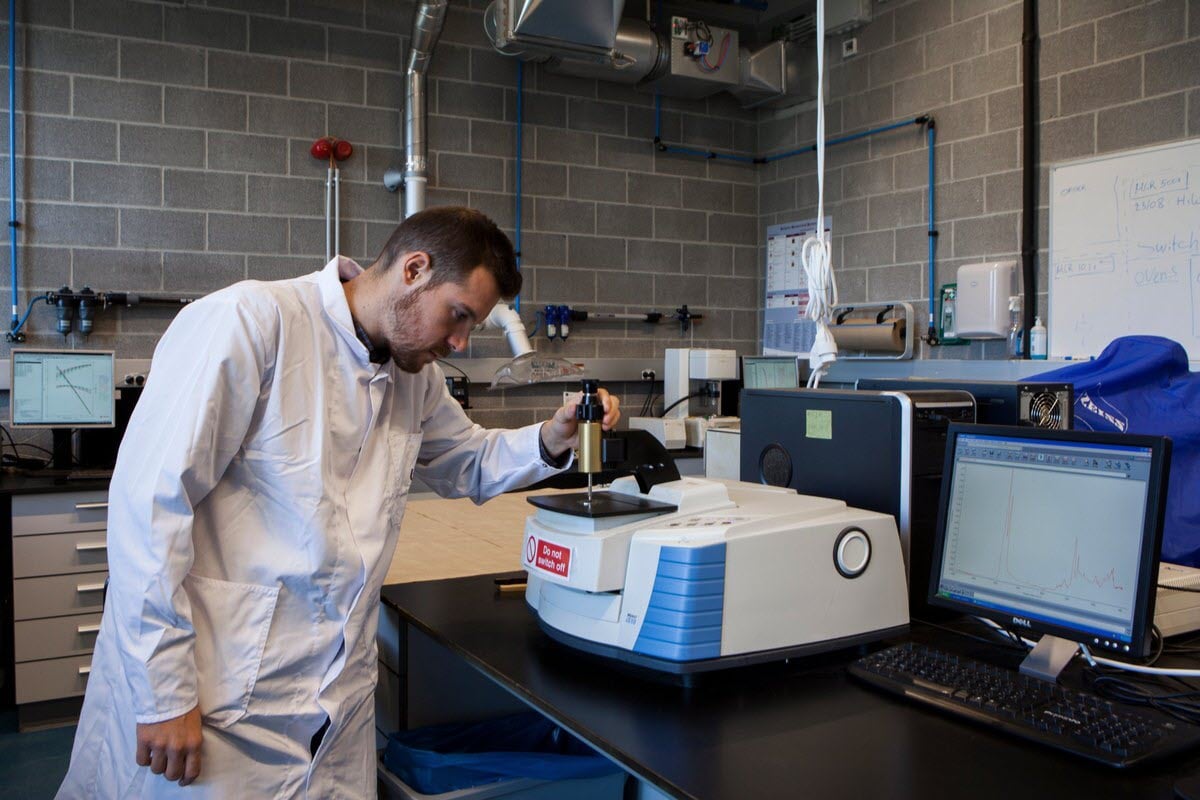
To bridge the gap, BRAVE combines thermal, spectroscopic, microscopic and rheological analyses with multivariate statistics. The aim is to “unravel hidden patterns” and explain the physical and chemical behaviour of the new bio-composites.
Built for a third life
BRAVE also looks beyond the first round of recycling.
A road built with bio-binders and RAP will itself be milled up one day, so the question is whether it can be recycled yet again.
“Creating new materials for asphalt construction which are durable is not enough,” he says.
“Ensuring that these materials can be reused in future life cycles for the same or similar construction sector is essential.”
To test this, the blends will be aged in the laboratory to simulate years of service on the road. The aged materials will then be assessed for their potential to be recycled once more.
Academia and industry together
Coordinated by Aristotle University of Thessaloniki and funded through Horizon Europe (Marie Skłodowska-Curie Actions), BRAVE runs from October 2026 to September 2028. TU Wien and Nynas are project partners, and Pipintakos will spend time working at both.
Nynas brings experience with bio-extended bituminous binders from previous research projects and will provide support for the chemical investigations. Dr Xiaohu Lu, Chief Scientist at Nynas, serves as the project’s industrial tutor.
“Everyone wants to try new things, but we have to have guaranteed long-term performance and durability,” says Lu.
“That is fundamental, and it’s what we want to understand better.”
For Pipintakos, this kind of collaboration means that “industrial challenges can be addressed from an academic perspective to the benefit of society, the environment and industry at large”.
From the lab to the road
BRAVE works at binder level only – a first screening step before any larger-scale application.
One of its key questions is whether biogenic bio-binders can fully take the place of the fresh bitumen normally added to recycled asphalt, at both moderate (30 percent) and high (60 percent) recycling rates.
“This is the first check for screening RAP before going into application at larger scales, such as in-situ testing tracks,” says Pipintakos.
His own biggest question is whether the biogenic component can be quantified in these bio-composites – and if so, what happens to it over multiple life cycles.
“In the end, are we creating something that we can claim as a sustainable policy for asphalt construction?” he asks.
“Are we BRAVE enough to give an answer to these questions? We will certainly know in a few years from now.”