From fluid science to grid value
Six industry papers from Nynas show how insulating-liquid innovation is advancing transformer performance, sustainability and diagnostics.
At CIGRE Paris 2026, Nynas contributed to six papers developed with utilities, transformer manufacturers, research institutes and technology companies. Together, they address thermal-hydraulic design, transformer uprating, cold-start behaviour, paper ageing, biodegradability testing and dissolved-gas diagnostics. Three of the papers examine the next-generation bio-based hydrocarbon insulating liquid NYTRO® BIO 300X in detail.

A portfolio built with the industry
The value of this contribution lies not only in the number of papers, but in the breadth of the collaboration. The work connects fluid formulation with transformer design, utility operation, laboratory methods and standardised diagnostics. Nynas specialists contribute liquid-property knowledge while partners provide equipment, field requirements, modelling capability and independent test perspectives. The result is evidence that can be used by designers and asset owners rather than product claims in isolation.
|
Paper
|
Collaboration |
Technical focus |
|
Modelling the Thermal-Hydraulic Behaviour of Shell-Type Power Transformers |
Efacec; University of Minho; Nynas |
Influence of fluid properties in OD and ON cooling modes |
|
Uprating a Spare Transformer by Improving its Thermal Performance Using Bio-based Hydrocarbon Oils |
DEP/Alliander; Elettromeccanica Tironi; Nynas |
Thermal upgrade and NYTRO BIO 300X retrofill |
|
Studying Cold-Start Thermal Response of Oil-Immersed Power Transformers at Low Ambient Temperatures |
NTNU; SINTEF; Siemens Energy; Kolektor Etra; Nynas |
Low-temperature start-up and fluid-dependent thermal response |
|
Ageing Kinetics of Insulating Paper Immersed in a Near Carbon-Neutral Re-refined Oil |
EDP Labelec; NOVA-FCT; Nynas |
Paper ageing with re-refined insulating oil |
|
Biodegradability Testing of Transformer Insulating Liquids: Decoding OECD 301 for the Electrical Industry |
GE Vernova; Nynas |
Method selection, sample preparation and interpretation |
|
The Effect of Hotspot Conditions on DGA Key Gas Generation on Novel Insulating Liquids |
Nynas |
DGA behaviour of mineral, re-refined and bio-based liquids |
NYTRO BIO 300X: thermal performance translated into capacity
The uprating study offers the clearest link between liquid properties and operational value. A 50/10 kV, 24/30 MVA ONAN/ONAF spare transformer was modified by doubling the fan count from six to twelve and replacing the original inhibited mineral oil with NYTRO BIO 300X, a low-viscosity bio-based hydrocarbon insulating liquid. The fluid’s lower viscosity, lower density and higher thermal expansion coefficient support stronger natural circulation and heat transfer through windings, tank and radiators.
Extended heat-run testing separated the effects of the fan and fluid modifications. At the 30 MVA ONAF reference, the combined changes reduced top-oil rise by 3.2 K, calculated LV winding rise by 10.2 K, calculated LV hotspot rise by 9.0 K and measured LV hotspot rise by 17.1 K. The authors recalculated loadability against IEC temperature limits and concluded that continuous operation at approximately 125% of the original rating was achievable for this unit, with the fluid change accounting for most of the net gain. They also note that radiator capacity constrained the full potential and that the fibre-optic readings were not used as the basis for uprating because sensor placement may not have captured the revised absolute hotspot.
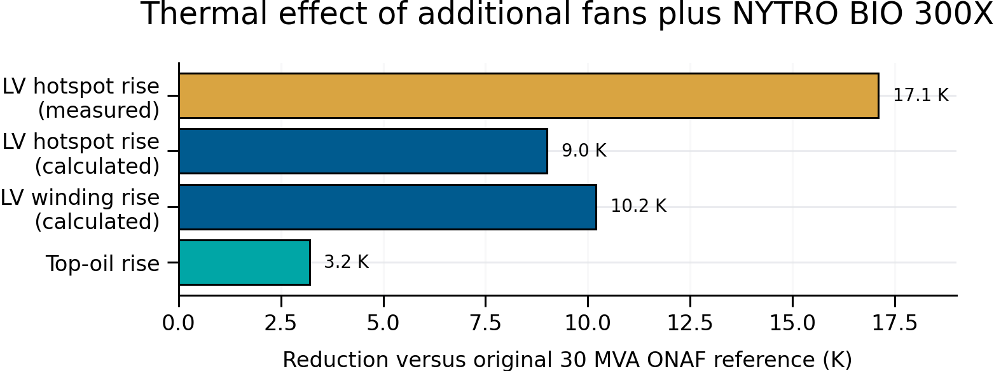
Figure 1. Temperature-rise reductions reported for the combined fan and NYTRO BIO 300X modification. Adapted from Leich et al.
Environmental performance depends on how the test is run
The biodegradability paper places NYTRO BIO 300X in a wider comparison of eight insulating liquids tested under OECD 301 B and 301 F protocols. Its central message is methodological: these tests were developed for water-quality applications, while hydrocarbon insulating liquids are poorly water-soluble. Microbial access, inoculum, laboratory practice and especially sample dispersion can therefore change the result and its classification.
Without a dispersant, the bio-based hydrocarbon oil reached about 40–50% biodegradation after 28 days and was classified as inherently biodegradable. In OECD 301 F testing with an inert silicone-oil dispersant, the reported result increased to about 93%, above the 60% threshold for “readily biodegradable”, while inter-sample variation fell. The paper does not argue that one preparation should be selected to obtain a preferred label. Rather, it calls for harmonised methods and interpretation that are suitable for hydrophobic insulating liquids. It also stresses that biodegradability is not the same as toxicity and that no insulating liquid should be released freely into the environment, biodegradable or not.
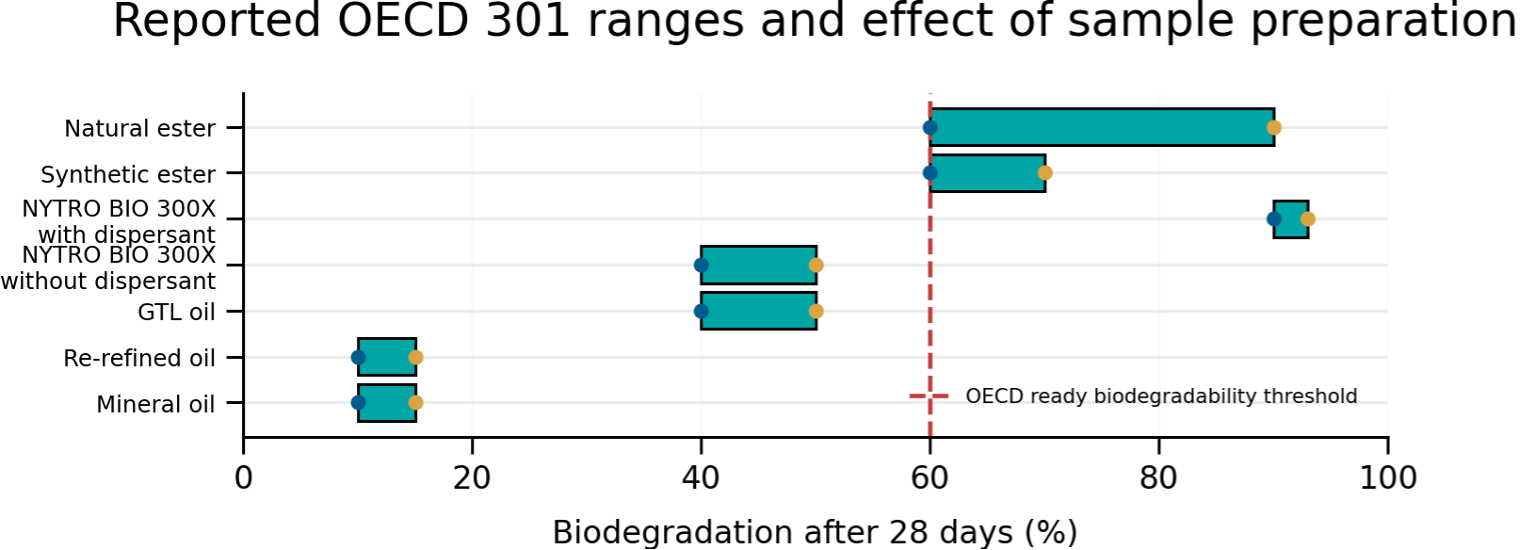
Figure 2. Indicative ranges reported across liquid types; the NYTRO BIO 300X result changes markedly with dispersion. Adapted from Norrby et al.
Diagnostics for a new fluid generation
The third NYTRO BIO 300X paper asks a practical asset-management question: can established dissolved gas analysis methods still be used when fluid feedstocks change? The study compared an inhibited mineral oil, a re-refined mineral oil and NYTRO BIO 300X in a tube-heating rig at a 550°C hotspot, corresponding to a T2 thermal fault. The rig was redesigned to minimise headspace because gases do not partition equally between liquid and gas phases.
That design detail proved decisive. With a large headspace, the Duval Triangle 1 interpretation misclassified the bio-based liquid’s simulated T2 fault as T3. With no headspace, the Duval Triangle correctly indicated T2 for all three liquids. The reported CH₄/H₂ ratio for NYTRO BIO 300X fell from 16.5 to 3.4, and C₂H₄/C₂H₆ from 1.2 to 0.8. The latter ratio would indicate T1 under IEC 60599, an unresolved discrepancy that the authors identify for further investigation. Overall, the alternative liquids showed DGA characteristics similar to conventional mineral oil, but the work also demonstrates why experimental configuration must be controlled before diagnostic conclusions are transferred to service practice.
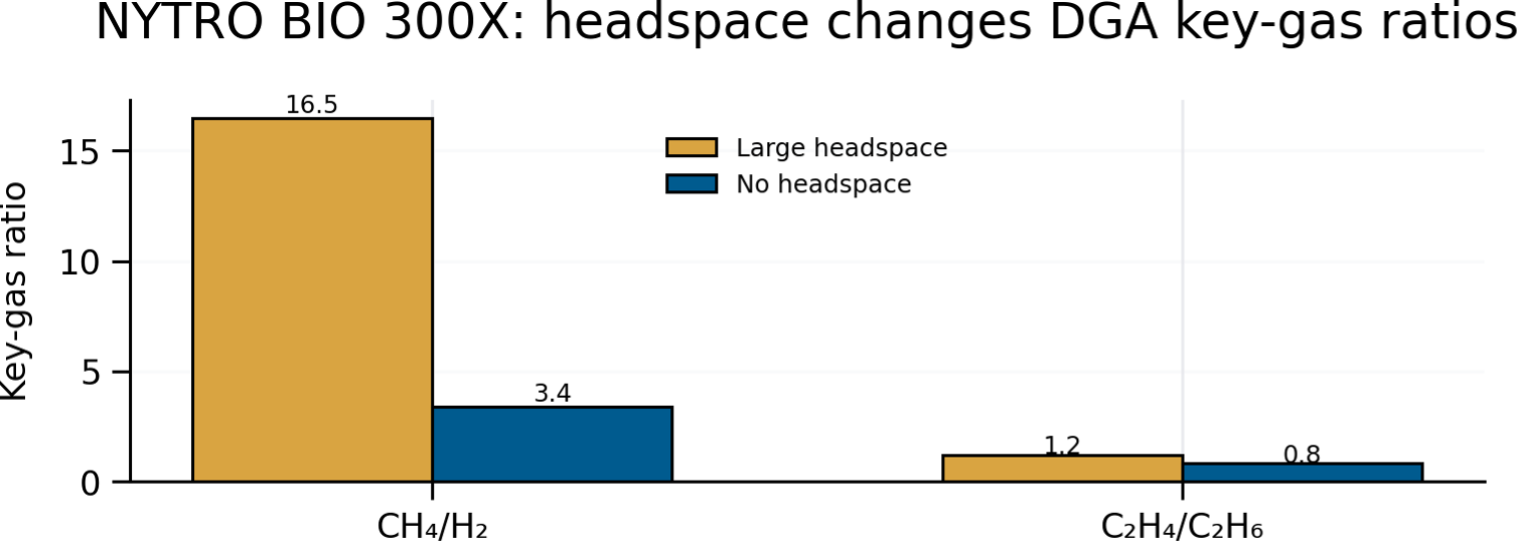
Figure 3. Reported NYTRO BIO 300X key-gas ratios under large-headspace and no-headspace conditions. Adapted from Wedin et al.
One liquid, three different questions
Taken together, the three papers show why transformer-liquid innovation must be evaluated as a system. In the uprating study, fluid properties influence circulation, temperatures and usable capacity. In the biodegradability study, chemistry interacts with the test method and sample preparation. In the DGA study, gas solubility interacts with the laboratory set-up and diagnostic ratios. None of these questions can be answered by a single property value.
|
Design & operation |
Environmental assessment |
Condition monitoring |
|
Low viscosity can lower winding and hotspot temperatures and create uprating margin, subject to the transformer’s complete thermal design. |
OECD 301 outcomes for hydrophobic liquids depend strongly on method and dispersion; transparent reporting is essential. |
Conventional DGA tools remain promising, but gas partitioning and remaining ratio discrepancies require careful validation. |
Conclusion
Nynas’ six-paper contribution reflects a collaborative approach to the energy transition: combine liquid science with transformer engineering, utility needs, independent research and established standards.
The three NYTRO BIO 300X studies provide complementary evidence that a next-generation bio-based hydrocarbon fluid can support thermal performance, environmental objectives and familiar asset-diagnostic practices.
Just as importantly, the papers are explicit about boundaries: uprating remains unit-specific, biodegradability classifications are method-sensitive, and DGA interpretation still merits further work. That combination of progress and transparency is what turns material innovation into dependable power-system value.
SOURCE PAPERS
• R. Leich et al., “Uprating a Spare Transformer by Improving its Thermal Performance Using Bio-based Hydrocarbon Oils”, CIGRE Paris Session 2026.
• T. Norrby, H. Campelo and C. Perrier, “Biodegradability Testing of Transformer Insulating Liquids: Decoding the OECD 301 for the Electrical Industry”, CIGRE Paris Session 2026.
• P. Wedin et al., “The Effect of Hotspot Conditions on DGA Key Gas Generation on Novel Insulating Liquids”, CIGRE Paris Session 2026.